
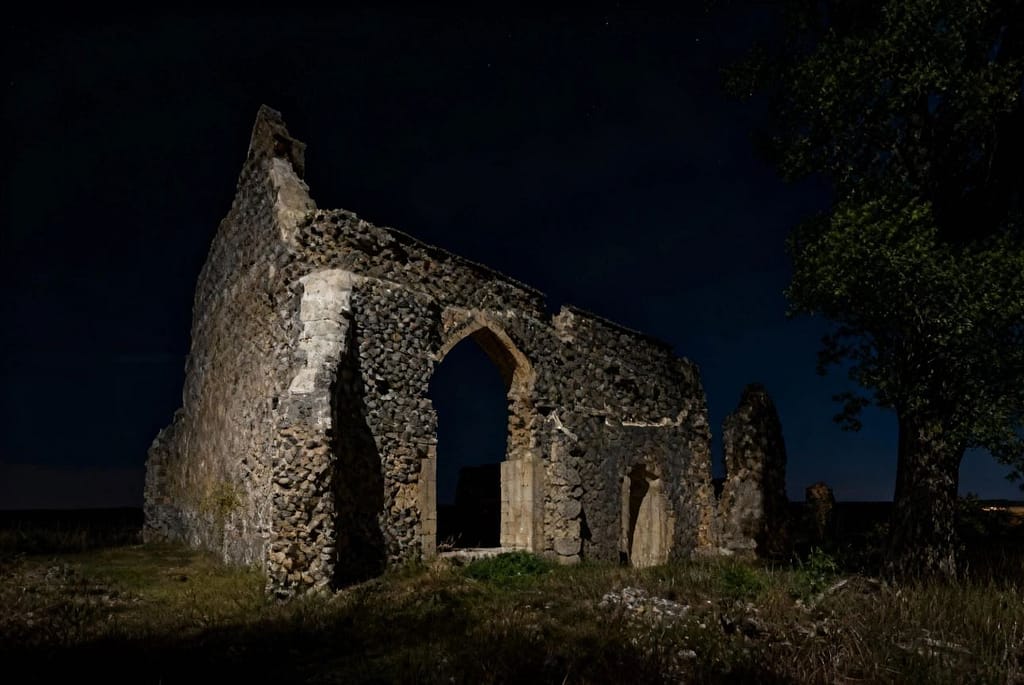
A Ruined Chapel Hidden in the Fields
Minsden Chapel stands, or rather crumbles, in fields above the hamlet of Chapelfoot near Preston, Hertfordshire. Built in the 14th century, it fell into decay by the 17th century, yet marriages and services carried on here into the 18th century despite the crumbling stone.
Today it is a roofless shell, partially ringed by trees and accessible only by footpath. Broken walls and fallen arches give it a stark, lonely beauty that feels tailor‑made for ghost stories.
History of Collapse and Devotion
Even as the chapel deteriorated, people clung to it. One story tells of a wedding in 1738 where falling masonry knocked the prayer book from the curate’s hands during the vows, a sign that the building had finally become too dangerous to use.
In the 20th century, local historian Reginald Hine became obsessed with Minsden, securing a lifetime lease and visiting often. He loved the ruin so much that he warned trespassers he would “endeavour, in all ghostly ways, to protect and haunt its hallowed walls” after his death. His ashes were later scattered at the chapel, and a memorial stone still lies there.
The Famous Monk Photograph and Hoax
In 1907, photographer Thomas William Latchmore took a now‑famous image showing a ghostly monk emerging from the chapel arch. For years it was held up as proof of the haunting. Only decades later did Latchmore admit the figure was a deliberate double‑exposure experiment, not a real ghost.
Despite the hoax, the photograph cemented Minsden Chapel’s reputation. People came expecting a monk, and soon stories of a real phantom monk began to circulate, as if belief itself had helped shape the legend.
The Headless Monk and Ghostly Bells
The most persistent tale is of a monk who appears at midnight on Halloween, climbing non‑existent stairs in the north‑east corner of the ruin. Some versions say he is headless; others describe a hooded figure whose features are hidden in shadow.
Witnesses and investigators also speak of distant, phantom bells ringing from the empty chapel, and of faint medieval‑style music drifting on the wind. Occasional reports mention a glowing cross appearing on the wall, fading and reappearing as if lit from within.
Other Legends and Eerie Details
Local lore adds more colour: rumours of a secret tunnel linking the chapel to nearby Temple Dinsley, tales of a murdered nun, and hints of hidden burials beyond what is recorded in church documents. While hard to prove, these stories contribute to the powerful sense that Minsden is more than just pretty ruins.
Paranormal investigator Peter Underwood once spent a night here and reported hearing distant music and seeing a white glowing cross, though he admitted moonlight and imagination might explain part of what he saw. His caution underlines how subtle, and how subjective, many Minsden experiences are.
Why Minsden Chapel Works for Paranormal Explorers
Minsden Chapel is not a pub or a hotel; it is a fragment of sacred architecture left open to the elements. That makes it a perfect site for low‑impact, respectful vigils rather than large public events. Small groups can sit quietly within the walls, watching the broken arch, listening for bells and noting any changes in light or temperature.
Because access is via footpath and the site is fragile, anyone visiting for paranormal reasons should treat it gently, following local guidance and avoiding damage. Done with care, a night at Minsden offers a very different kind of ghost‑hunt experience – one rooted in landscape, history and suggestion as much as in sudden phenomena.
Ruined Chapels and DeadLive Ghost Hunts
Minsden Chapel shows how even half‑forgotten ruins can become powerful focal points for ghost lore. When you join DeadLive ghost hunts across the UK, many of the indoor venues share the same blend of faith, fear and long‑term devotion that keeps places like this alive in local memory.
DeadLive would love to explore more ruined churches and chapels in future, building folklore nights around them, but right now events are focused on locations such as Lark Lane Old Police Station Liverpool, Mayer Hall Wirral, Vernon Institute Chester, Penrhyn Old Hall, Coffee House Wavertree and the Transport Museum Manchester.
DeadLive – taking you where the haunting is happening.