
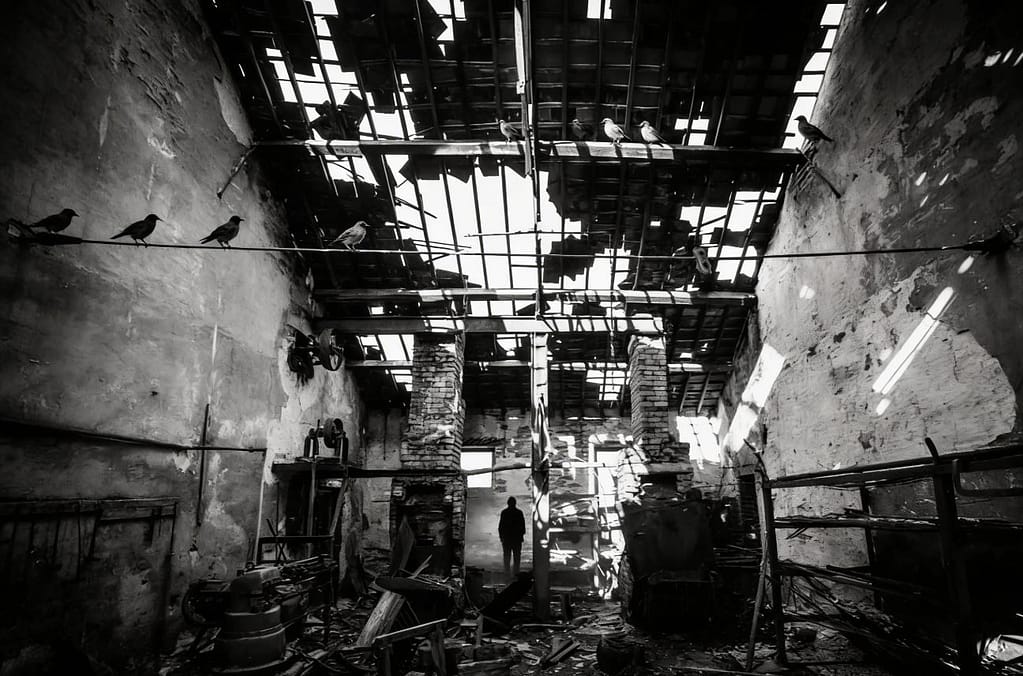
Wrexham’s Industrial Shadows
Wrexham is often celebrated for its football and market streets, but look just beyond the shopfronts and you find a town built on heavy industry. Coal, iron, brewing and engineering shaped the skyline and the lives of thousands of workers.
Those days are fading, yet the echoes remain. Disused mills, converted foundries and old rail sidings carry stories of long shifts, sudden accidents and lives lived to the relentless rhythm of machinery. It is in these half‑forgotten spaces that people still report strange footsteps, phantom whistles and figures that don’t belong to the present.
Ghosts in the Mills and Workshops
Wrexham’s mills once roared with noise: belts hissing, gears grinding and workers shouting over the din. Many of these buildings have since been repurposed as offices, apartments or storage, but the past has a habit of bleeding through.
Staff in some converted mills speak of hearing the steady clank of metal on metal from bare rooms, as if a lone worker is still at his bench. Others describe the sensation of someone passing close behind them in narrow corridors, accompanied by the faint smell of oil and hot metal, even though the building hasn’t housed heavy machinery for decades.
One particularly unsettling report comes from a stairwell where people often feel a sudden “drop” in their stomach, as if the steps beneath them have vanished for a moment. Locals quietly link this to an old story of a worker who fell from an upper floor while carrying tools, though the details are long lost. Whatever the truth, something about that spot still makes modern passers‑by grip the handrail a little tighter.
Foundries, Firelight and Residual Hauntings
Ironworks and foundries around Wrexham were harsh places: glaring furnaces, showers of sparks and men working in stifling heat. Many accidents simply never made it into official records; they became whispers passed between families and colleagues.
On still nights, people living near former foundry sites have reported a low, distant roaring sound, like a furnace being drawn up to heat, despite no active works nearby. Some have seen a dull red glow behind high windows in disused buildings, fading as they watch, leaving only darkness.
Investigators who have spent time in these areas speak of sudden hot and cold spots that make no sense with the layout of the building. In one case, a small team reported seeing a silhouette cross in front of a high gantry, clearly outlined against a light that wasn’t there. When they approached, they found only corroded railings and a drop to the floor below. Whether this is a residual trace of past activity or something more aware, the foundry sites remain some of Wrexham’s most quietly unnerving places.
Rail Yards and Phantom Whistles
Rail lines and sidings played a vital role in moving coal and goods in and out of Wrexham. Signals, shunting engines and long lines of wagons once dominated parts of the town. With many sidings removed or reduced, the remaining infrastructure can feel oddly out of time.
Local walkers using footpaths along old lines sometimes report the clear sound of a steam whistle carried on the air, at times when no heritage services are running. Others have heard the clatter of wheels over rails that no longer exist, the sound building and then stopping abruptly as if a train has slid into an invisible station.
There are also accounts of a solitary figure in railway overalls seen near disused signal posts or standing on embankments, gazing down the line. When approached, the figure seems to step behind a structure and vanish. Late‑night drivers passing under certain bridges speak of a brief, disorienting moment where they feel as though they are passing through smoke, catching the tang of coal in the nose, only for it to disappear as quickly as it came.
Miners’ Spirits on the Edge of Town
Though some of the pits associated with Wrexham now lie beyond the town centre, their legacy is tied closely to its industrial story. Mining brought wealth and tragedy in equal measure, and many families carry memories of disasters that reshaped entire communities.
Stories persist of phantom lights seen bobbing near old pit entrances or along former tramways at night, like lanterns carried by men coming off shift. People walking dogs or returning home late have also heard the muffled sound of voices below ground – indistinct, overlapping, as if men are talking and laughing in a distant tunnel.
In a few places where spoil heaps have been landscaped into green spaces, there are reports of dogs freezing, hackles raised, at apparently empty patches of path. Owners describe feeling as though they have walked into a patch of air that is somehow “crowded,” even though they are completely alone. The idea that layers of memory still lie beneath the grass is hard to shake.
Why Industry Breeds Hauntings
Industrial sites combine several elements that frequently appear in paranormal accounts: intense human emotion, physical danger and repetitive activity. Mills, foundries, rail yards and pits were places where people invested their entire lives, often under an ever‑present threat of injury or worse.
From a paranormal perspective, these conditions are perfect for residual hauntings – impressions of sound, light and movement that replay without awareness. Sharp, repeated noises like hammer blows or whistles seem particularly prone to echoing forward in time as anomalies people can still experience today. At the same time, sudden deaths and unresolved accidents may contribute to more intelligent hauntings, with spirits drawn back to the only environment they ever truly knew.
For investigators, that makes Wrexham’s industrial heritage especially compelling. Old brick, metal and earth can hold stories as effectively as any castle wall or country house staircase.
Exploring Wrexham’s Industrial Ghosts
Anyone interested in Wrexham’s haunted side should consider walking its industrial edges – the converted mills, shadowed yards and quiet rail cuttings that most people pass without a second thought. Taking note of how the atmosphere changes from site to site, and carefully logging unusual sounds or sensations, can build a surprisingly rich picture over time.
If these stories of working‑class hauntings and industrial echoes resonate with you, you will find similar depth at our Liverpool ghost hunts and on DeadLive events Cheshire. There, we focus on locations where ordinary lives and extraordinary events overlapped, using structured methods and equipment to explore the kind of phenomena that still seem to stir in places like Wrexham’s mills and rail yards.
We would love to investigate this location, but right now we are running events at Lark Lane Liverpool, Mayer Hall Wirral, Vernon Institute Chester, Penrhyn Old Hall, Coffee House Wavertree, Transport Museum Manchester.
DeadLive – taking you where the haunting is happening.