
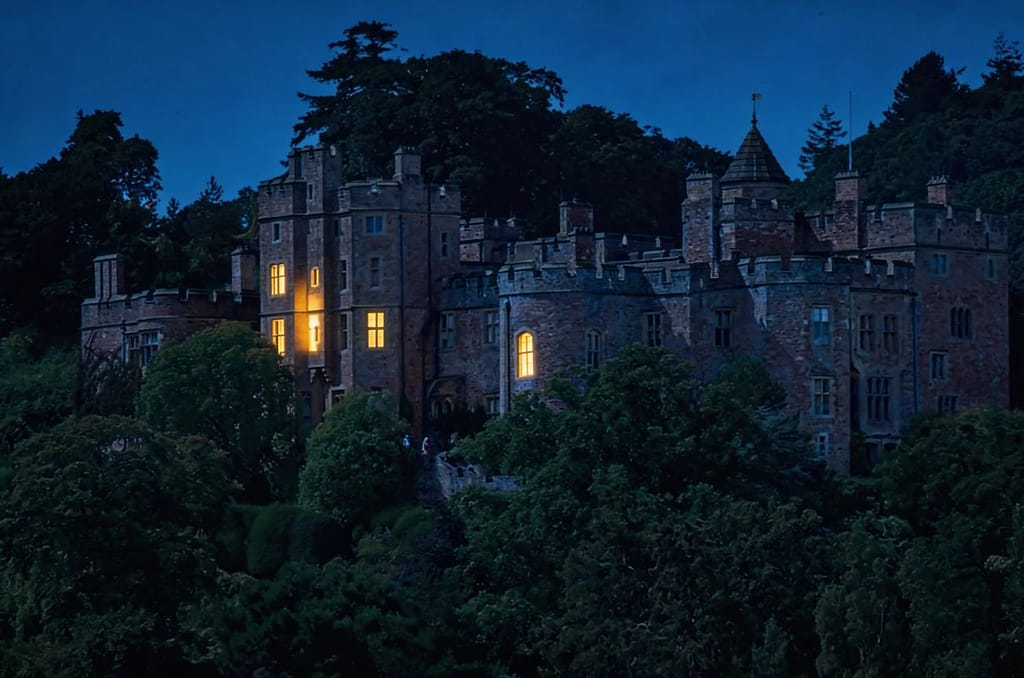
Dunster Castle stands on a steep hill above the medieval village of Dunster, watching over Exmoor and the West Somerset coast like a stone sentinel. Dating back to the Norman conquest, it began as an 11th‑century stronghold built by William de Mohun and later became the long‑term seat of the Luttrell family for around six centuries. Over the years it has seen siege, civil war, imprisonment and quiet Victorian domestic life, leaving layers of history that feel almost alive as you walk its corridors.
Today, the National Trust cares for Dunster Castle and openly embraces its reputation as one of its most haunted properties. Staff, volunteers and visitors regularly report cold spots, strange sounds and full‑blown apparitions, and the site even hosts structured ghost tours through the darker corners of the castle. For anyone who loves ghost hunts and eerie locations, Dunster Castle is a dream – or possibly a nightmare – waiting to happen.
The Grey Lady and Civil War Soldiers
One of Dunster Castle’s best‑known spirits is the Grey Lady, said to glide along the grand oak staircase before vanishing into a solid wall. Generations of the Luttrell family were reportedly unnerved by her, and staff still describe icy chills and the sense of someone brushing past them on the stairs when no one is there. Some believe she is a tormented servant girl connected to this staircase; others suggest a member of the Luttrell family or even the mother of a Civil War commander.
She is not alone. A spectral “foot guard” in an old‑fashioned military uniform has also been seen, matching the era when Royalist troops held Dunster during the English Civil War. In one case, a cleaner encountered a uniformed man in a room later identified as a former Civil War soldiers’ dormitory, a detail she did not know beforehand, which gives this sighting extra weight for investigators. For a modern ghost hunt, the oak staircase and adjacent corridors would be prime spots for EVP sessions, motion sensors and temperature monitoring.
The Oubliette and the Seven‑Foot Skeleton
Beneath the gatehouse lies one of Dunster Castle’s darkest secrets: an oubliette – a hidden dungeon where prisoners were dropped and forgotten. Excavations in the 17th and 19th centuries uncovered several skeletons in this pit, including one astonishingly tall man, reportedly over seven feet, still shackled by wrists and ankles to the wall. The remains were left in situ and the pit later covered over, so visitors today walk across tiled flooring with the dead still below.
From this area, people report chilling cries, distant screaming and a heavy, oppressive atmosphere, especially on quiet evenings. For paranormal teams, this space naturally lends itself to structured vigils in low light with controlled audio recording; any disembodied voices captured here could potentially be compared with the human cries witnesses describe. Because of the tragic history involved, it also demands a respectful approach, something seasoned investigators will already value.
The Man in Green and the Haunted Stable Block
Outside the main castle, activity clusters around the 17th‑century stable block, now converted into the National Trust gift shop. Staff frequently see a man dressed head‑to‑toe in green walking through the shop area towards the stables before simply disappearing, which has earned him the nickname “The Man in Green”. Sometimes a faint, bobbing green light is seen drifting through the space, leading some to wonder whether the light and the apparition are manifestations of the same entity.
Visitors and workers alike describe a sudden drop in temperature and an odd sense of dread at the far end of the stable block, even on hot days. There are also curious physical anomalies: unopened boxes in the shop have reportedly been found ruined by an unexplained brown, sticky substance with no clear source. For a ghost‑hunting event, this area would be perfect for controlled walk‑throughs, EMF sweeps and light‑anomaly monitoring, as well as simple human observation – just standing quietly to see whether that chill appears on cue.
The Blue Kitchen and Everyday Hauntings
Hauntings at Dunster Castle are not limited to dungeons and staircases. In the 1950s–60s “Blue Kitchen,” preserved as a mid‑20th‑century room, a volunteer once looked down and saw a disembodied, naked human foot in front of him before it vanished. On another occasion during a paranormal event, several sensitives claimed to connect with a young servant girl hiding inside a dumb waiter; when the hatch was opened, witnesses reported a piercing scream from elsewhere in the castle at the same moment.
Elsewhere, staff speak of coins clinking when no one is near the old upper wards, echoing Dunster’s medieval role as a place where money was once minted. Dogs sometimes react to things their owners cannot see, growling or refusing to enter certain spots, which the National Trust themselves note as part of the castle’s “sinister sensations”. For teams used to bringing trigger objects, motion‑activated balls or REM‑pods, these domestic rooms and passages offer atmospheric backdrops to watch for subtle, intelligent interaction.
Why Dunster Castle Suits Modern Ghost Hunts
Dunster Castle has almost everything an investigator could want: deep medieval roots, Civil War conflict, documented imprisonment and a long run of modern eyewitness reports. The mix of grand interiors, claustrophobic staircases, subterranean spaces and outbuildings such as the stable block creates a variety of environments to test different techniques, from careful EVP work in the oubliette area to more experiential walk‑around vigils near the oak staircase.
Although Dunster is currently run as a National Trust attraction with its own seasonal ghost tours, its set‑piece stories – the Grey Lady, the Man in Green and the seven‑foot skeleton – make it an ideal candidate for structured, hosted investigations if permissions allow. It would sit perfectly alongside other historic properties on our ghost‑hunt calendar, appealing to guests who enjoy both strong history and active hauntings in one location. If you love the idea of exploring atmospheric castles, keep an eye on our ghost hunts and paranormal events pages on www.deadlive.co.uk for future announcements and ways to book a ghost hunt with DeadLive.
We would love to investigate Dunster Castle in Somerset and bring a team into its haunted staircases, oubliette and stables. Right now, we are running events at locations such as Lark Lane Old Police Station Liverpool, Mayer Hall Wirral, Vernon Institute Chester, Penrhyn Old Hall, the Old Library Liverpool and the Transport Museum Manchester. To explore upcoming dates and venues, visit our ghost hunts and paranormal events pages on www.deadlive.co.uk and book a ghost hunt with DeadLive.
DeadLive – taking you where the haunting is happening.