
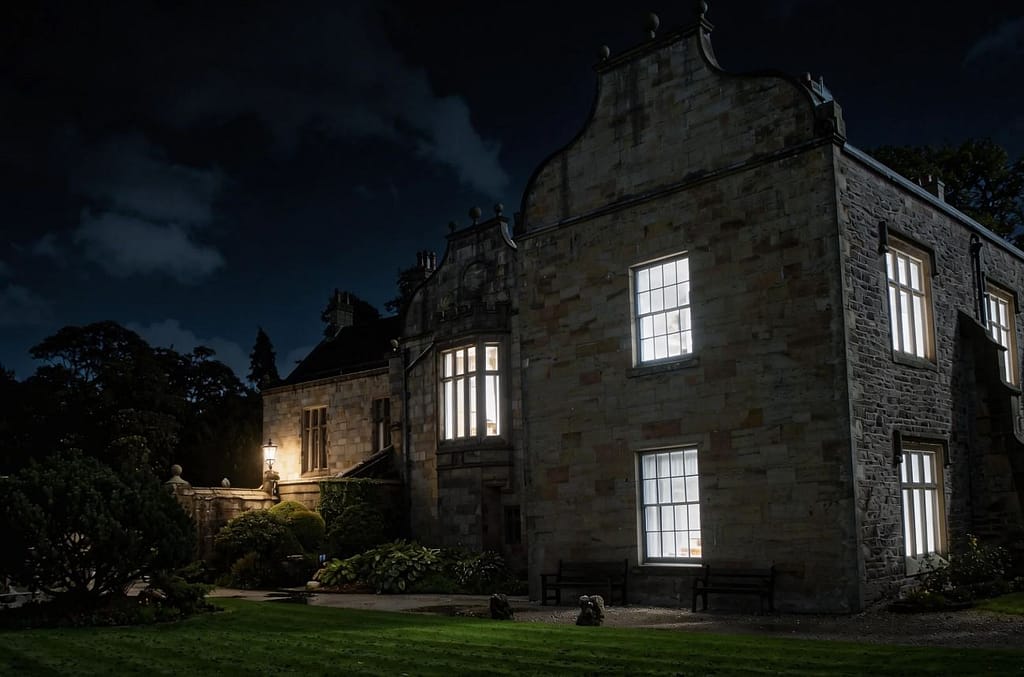
Whalley Abbey Ruins A Broken Monastery
Whalley Abbey stands beside the River Calder in the Ribble Valley, a shell of stone that once housed one of Lancashires richest Cistercian houses. Monks moved here from flood prone Stanlaw Abbey in the late thirteenth century, drawn by solid ground and water power. Over the next two centuries they raised a great church, cloister and domestic ranges that dominated the village.
The peace ended in the sixteenth century. Henry VIIIs break with Rome brought the Dissolution, and Whalley was surrendered and stripped in 1537. Much of the church came down, its stone scattered into farms and houses across Lancashire. Yet among the broken walls and green lawns, people still speak of chanting, processions and a stubborn abbot who refuses to leave.
Procession of Phantom Monks
One of the oldest tales from Whalley Abbey describes a silent line of monks crossing the ruins after dark. Witnesses talk of a Te Deum rising on the night air, a hymn of praise that once filled the abbey church. The voices seem to come from nowhere and everywhere at once, echoing off walls that no longer stand.
As the sound builds, a procession appears among the arches. Figures in white habits walk two by two, heads bowed and hands clasped in prayer. They follow a route that once ran along the nave, past the high altar and toward the cloister, oblivious to any modern observer. When they reach the edge of the surviving walls they simply fade, leaving only the rustle of leaves and the river.
Not everyone hears the chanting. Some visitors only sense a change in the air, a hush that falls over the site as if a service has begun. Birds fall silent, conversation dies away and a feeling of reverence mixed with unease creeps in. It is as though the monastic routine has imprinted itself on the landscape and still plays out on certain nights.
Abbot Paslew and the Fatal Oath
At the heart of many Whalley stories stands John Paslew, the last abbot. He rebuilt his own lodgings and added a Lady Chapel shortly before everything fell apart. When Henry demanded that churchmen accept him as head of the Church of England, Paslew resisted and became entangled in the Pilgrimage of Grace, a northern rising against royal religious changes.
For that defiance he was arrested, tried for treason and executed in 1537, probably at Lancaster. Local legend says his ghost walks between the ruins, the nearby countryside and the site of his former home at Wiswell. People speak of a lone monk figure, more substantial than the processional line, moving with the slow, heavy step of a man carrying both age and responsibility.
Some accounts describe this monk stopping at certain spots in the grounds, as if checking on the buildings that once stood there. Others say they have heard firm footsteps on gravel when nobody is visible, followed by a sudden stillness and the faint impression of someone watching from under a hood. Whether these stories reflect Paslew himself or a composite abbots presence, they tie the haunting firmly to the moment Whalleys world ended.
The Murdered Nun and the Lady in White
Alongside the monks, a different figure walks the edge of legend at Whalley. Stories tell of a visiting nun who came to the abbey and never left. She is said to have been kept within the community against her will and badly treated by some of the monks. Fearing exposure if she reported their behaviour to superiors, those responsible allegedly decided to silence her.
The tale claims she was killed as she tried to escape and buried secretly somewhere in the abbey grounds. In the centuries since, a pale female figure in white has been seen near the ruins, sometimes close to boundary walls, sometimes among the trees that fringe the site. Unlike the orderly monk procession, this ghost moves erratically, glancing back over her shoulder as if still fleeing unseen pursuers.
On calm evenings, a chill can hang around certain corners of the precinct even when the rest of the grounds feel mild. Visitors occasionally report a sudden wave of sadness followed by the urge to leave that particular spot. Whether or not the nun story reflects a specific historical person, it gives voice to the idea that not every soul within the abbey found peace or justice.
Echoes in Stone and Grass
Whalley Abbeys fabric has changed repeatedly since the Dissolution. The domestic buildings became a grand Elizabethan house, later remodelled and eventually turned into a retreat for the Diocese of Blackburn. Yet the footprint of the medieval precinct remains clear, and paths still follow lines set down in the fourteenth century.
People walking the ruins today notice how certain areas feel different. The site of the church, though mostly robbed of stone, holds a strong sense of enclosure when you stand where the nave once rose. The cloister garth, now a lawn, has a quietness that contrasts with the village just beyond the walls. It is in these zones that reports of chanting, footsteps and fleeting figures tend to cluster.
Stories of phantom monks, a restless abbot and a wronged nun may have grown and shifted with each retelling, but they all root themselves in real events. Whalley was built on hope, wealth and prayer, then torn apart by royal decree and human frailty. The ruins show the physical scars of that history; the ghost stories suggest the emotional ones still linger.
We would love to investigate this location, but right now we are running events at Lark Lane Liverpool, Mayer Hall Wirral, Vernon Institute Chester, Penrhyn Old Hall, Coffee House Wavertree, Transport Museum Manchester.
DeadLive taking you where the haunting is happening.